Thesis. The web has spent thirty years optimizing for browsing — a human reading documents one tab at a time. Chervil is built for what comes after: agentic action in the frontier-model era, where you say what you want and a system gathers, composes, operates, teaches, and publishes on your behalf. Chervil is that framework. Sprig is the bridge between you and it.
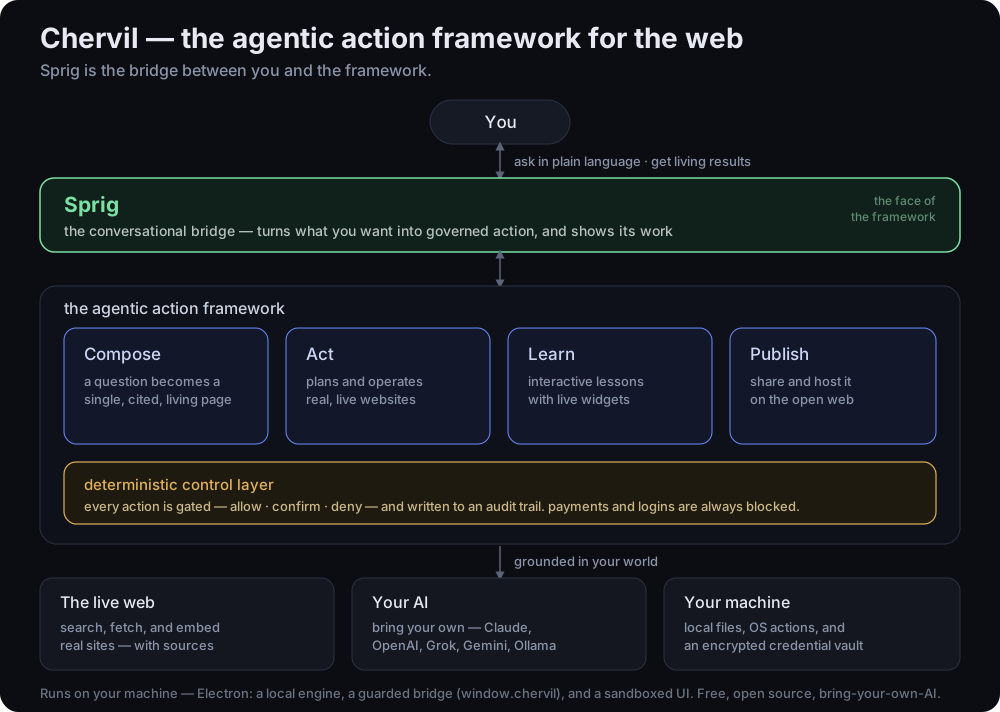
1. From browsing to action
A browser is a window onto documents. You do the work: search, open ten tabs, read, cross-check, copy things into a doc, come back tomorrow to see what changed. The interface assumes you are the agent.
The shift underway is bigger than "AI search." It's the move from answer engines — which hand you a fact — to agentic systems that do the work: assemble the page, run the steps, keep it current. What makes it possible now is the frontier-model era — models finally capable enough to be handed the doing, not just the answering. Chervil treats that as a framework, not a feature: a small set of action primitives, a single conversational entry point, and a hard boundary around anything that touches the real world.
The destination comes to you, purpose-built, every time. Not ten blue links.
2. Sprig — the bridge
Every framework needs an interface. Chervil's is Sprig — a conversational guide you actually talk to. Sprig is not a chatbot bolted onto a browser; it is the bridge in the architectural sense:
- It translates intent into action. You ask in plain language ("teach me Sentinel," "fill this form," "keep this page current"). Sprig decides which framework primitive applies — compose a page, operate the site, build a lesson, publish — and drives it.
- It carries results back. What the framework produces — a cited page, a running task, an interactive lesson — comes back through Sprig, in context, with its work shown.
- It is the only thing you address. There is one surface to learn, not a toolbar of modes. The omnibox is the same bar whether you're opening a real site, asking a question, or running a command.
Crucially, Sprig is a bridge, not an authority. It decides what to attempt; it does not get to decide, on its own reasoning, what is allowed. That distinction is the whole safety model (§4).
3. The framework — four action primitives
Underneath Sprig, the framework is deliberately small. Four primitives cover the surface area:
- Compose. A question becomes a single, self-contained, image-rich page — grounded in live web search, with its sources shown and one-click verification of its own claims. Pages can be told to stay live and re-ground themselves on a schedule.
- Act. Sprig operates real websites on your behalf: it drafts a short plan, then works through it step by step — searching, clicking, filling, navigating — adapting as the page reveals reality. (Governed by §4.)
- Learn. Sprig builds interactive lessons and graded quizzes. The "applet" card composes a real, self-contained interactive widget — dropdowns, simulators, live-computed output — that works in the app and on the published page.
- Publish. Any of the above — a page, a lesson, a quiz, a whole workspace — goes live to a shareable link that opens on any phone, with a public profile and optional cloud hosting that keeps it current for everyone.
These compose with each other: a lesson is composed, can be acted upon, and is published; a page can be learned from and kept living. One framework, four verbs.
4. The deterministic control layer
An agentic browser holds your keys and can act on your behalf — so "trust the model" is not good enough. Authority in Chervil does not live in the model's reasoning. A deterministic layer governs every action the framework is allowed to take:
- Every state-changing action is classified and gated — allow, confirm, or deny — by rules, not by the model's judgment.
- Sensitive categories are always blocked: entering passwords, completing payments, moving money. Sprig hands those back to you.
- Every action is written to an audit trail you can read.
- You grant permission per action, and approval in one place never silently generalizes to the next.
This is the load-bearing design decision: the model proposes, a deterministic policy disposes, and you stay in the loop for anything irreversible or outward-facing.
5. Grounded in your world
The framework is only as good as what it can reach. Chervil grounds in three things you already own:
- The live web. Real search and fetch (with citations), and the ability to embed and operate actual websites — not a model's stale memory of them.
- Your AI. Bring your own provider — Claude, OpenAI, Grok, Gemini, or local Ollama. Your keys, encrypted on your machine; the model is pluggable, the framework is not.
- Your machine. Local (and cloud-synced) files as context, read-only system facts, OS actions behind the control layer, and an encrypted, passphrase-locked credential vault that Sprig itself never sees.
6. How it runs
Chervil is a desktop application, and that is a feature, not a limitation. The capabilities that make it more than a browser — embedding live sites, reaching local files, holding keys locally, touching the OS — are precisely the ones a browser tab is forbidden to do.
Three parts, cleanly separated:
- A local engine. The compose-and-act pipeline (
lib/agent.js, the provider adapters inlib/models/*) runs in the app's main process, calling your chosen AI directly with your local keys. - A guarded bridge. A narrow, allow-listed surface —
window.chervil— is the only channel between the sandboxed UI and the engine. Composed pages and applets reach the framework through it; nothing else gets through. - A sandboxed UI. Everything you see renders in a locked-down view. Model-generated content (pages, interactive widgets) runs under a hardened content-security policy — interactive, but contained.
The same engine is what lets a published lesson's widgets work on the open web: they're baked into the page as self-contained, sandboxed mini-apps at publish time, so they stay interactive for everyone, with no live connection required.
7. Open, and built to be trusted
Because an agentic system holds your keys and acts for you, "trust me" isn't a model — it's a liability. Chervil is open source: read the code, run it, contribute. It is bring-your-own-AI: no model lock-in, no key custody by us. And it is local-first: your data, your machine, your control. The deterministic layer that governs every action is right there in the open, not a promise.
In one line: Chervil is the agentic action framework for the web — compose, act, learn, publish — and Sprig is the conversational bridge that turns what you want into governed action, grounded in the live web, your own AI, and your own machine.